Trane Furnace Repair in Arcadia
Answer in brief: Arcadia Trane HVAC repairs Trane gas furnaces across Arcadia, CA (91006) and Highland Oaks - igniter, flame-sensor, pressure-switch, and high-limit lockouts on XC95m, S9V2, and 80% XR80 models read by board flash code, repairs $150 to $2,300, so call (213) 772-7221 or book online for same-day no-heat help.
Key points
- Service area: Arcadia plus Highland Oaks, Baldwin Stocker, and Peacock Village (91006, 91007, 91077).
- We diagnose by the integrated furnace control LED flash code, not guesswork.
- Common Arcadia parts: hot-surface igniter, flame sensor, pressure switch, inducer motor, high-limit, ECM blower module.
- Trane furnace lines serviced: XC95m, XV95, S9V2, S9X2, XR95, and 80% XR80/XL80/XV80.
- Typical furnace repair cost lane: $150 to $2,300 depending on the part; full replacement $3,000 to $7,500.
- Same-day and after-hours service; cracked heat exchangers are red-tagged for safety.
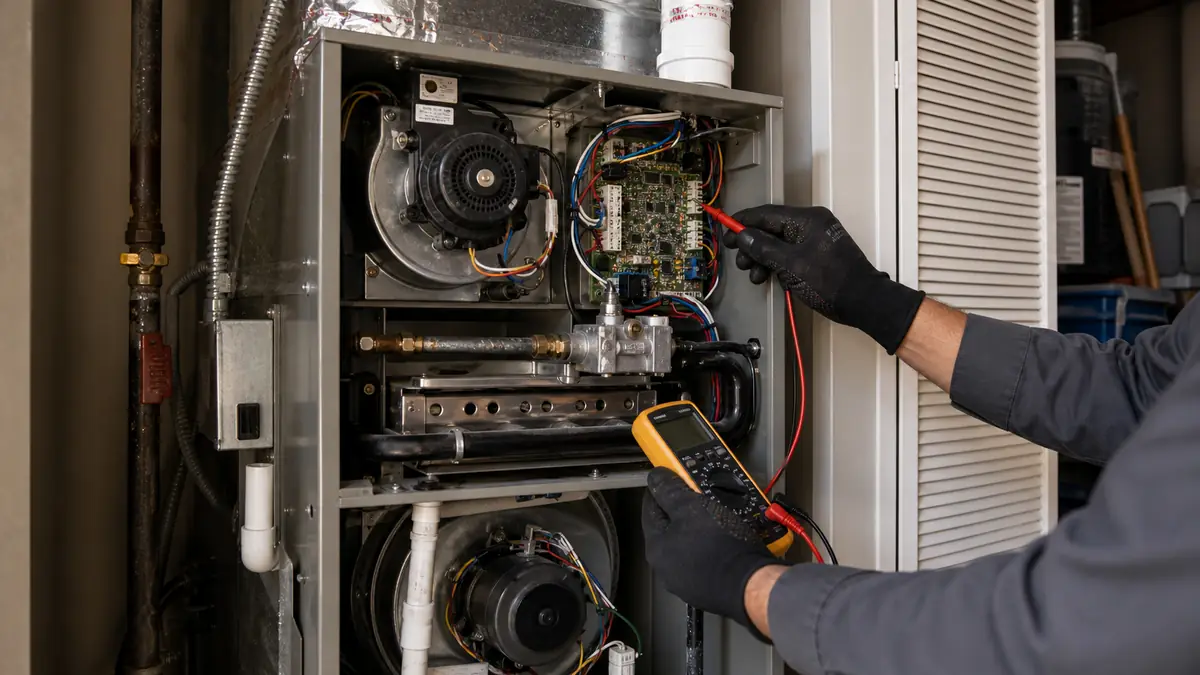
Why won't my Trane furnace light in Arcadia?
Most Arcadia no-heat calls trace to the ignition train or a safety switch doing its job. A worn hot-surface igniter or a flame sensor crusted with oxide is the top cause - the furnace tries, fails to prove flame, and locks out after a few retries (2 flashes). After that, the usual suspects are a stuck pressure switch or weak inducer motor (3 flashes) and an open high-limit from restricted airflow (4 flashes). We pull the code, scope the part, and confirm before replacing.
| Symptom / flash code | Likely cause / first check | Cost lane |
|---|---|---|
| Clicks, no flame; 2 flashes (lockout) | Worn hot-surface igniter or no gas / dirty flame sensor | $150 - $450 |
| Inducer runs, burners never fire; 3 flashes | Pressure switch stuck or blocked flue / inducer fault | $150 - $600 |
| Burners light then shut; 4 flashes | Open high-limit from low airflow, dirty filter, or coil | $120 - $500 |
| Lights, drops out; 8 flashes | Weak flame-sense signal, dirty flame rod | $120 - $300 |
| Furnace runs, faint gas smell; 5 flashes | Flame sensed with no call - gas valve leak-by or board | $300 - $900 |
| Will not power up; 9 flashes or 6 flashes | Igniter circuit fault, or reversed 115V polarity / poor ground | $120 - $450 |
| No blower on a heat call | Failed variable-speed ECM blower module or motor | $450 - $2,300 |
How does a Trane no-heat diagnosis actually go?
Pulling parts is the last step here, not the first. An Arcadia furnace call follows a set routine: read the integrated furnace control LED, count the flash code, and then make a meter confirm or kill that code before a single part comes off. Say the board throws 2 flashes (lockout) - we sit through a complete ignition attempt and watch each stage hand off to the next: the inducer spins up, the pressure switch closes, the hot-surface igniter comes up to temperature, the gas valve opens, and the flame rod has to register flame inside the trial-for-ignition window. From there we microamp the flame sensor (a healthy Trane rod reads roughly 1.5 to 6 microamps, and anything under about 0.5 drops it out), ohm-check the igniter, and verify the gas valve is actually getting its 24-volt call.
For a 3-flash pressure-switch code we read the inducer draft and inspect the flue and condensate trap, because a blocked secondary or a sagging condensate line on an S9V2 or XC95m will hold the switch open. For a 4-flash high-limit, we measure temperature rise and static pressure - if rise is over the nameplate range, the real fault is airflow, not the limit. Only then do we quote the part and the cost lane, in writing, before we replace it.
Which Trane furnace family is in your Arcadia home?
The right repair depends on the line, and Arcadia homes run the full spread. We service the premium modulating XC95m (modulating gas valve plus variable-speed ECM, up to about 97.3 percent AFUE) and the variable-speed XV95 (around 97 percent); the enhanced S9V2 two-stage with a variable-speed ECM blower (about 96 percent) and the S9X2 two-stage; the value single-stage XR95 and S9X1; and the budget 80 percent tier - XR80, XL80, XV80 - which is genuinely common and adequate in Arcadia's mild winters. The split that matters for cost: 80 percent furnaces are simple, atmospheric, and cheap to repair, while the condensing 9X-series adds a secondary heat exchanger, a condensate trap and drain, and on the variable-speed models an ECM blower module that is the single priciest non-exchanger part.
Which Trane furnace parts fail most in foothill homes?
In Arcadia's dusty, dry foothill air, flame sensors oxidize and igniters crack from thermal cycling faster than people expect. We carry universal and Trane-spec igniters and flame rods on the truck. On the higher-efficiency S9V2 and XC95m, the variable-speed ECM blower module is the pricier failure; on 80% XR80 furnaces, it is usually the igniter, pressure switch, or a simple roll-out reset after a long-blocked flue. We always confirm the heat exchanger is intact with a combustion analyzer before signing off.
What does a Trane furnace repair cost in Arcadia, and why?
Most Arcadia furnace repairs land between $150 and $2,300, and the spread is almost entirely about which part failed, not the brand badge. The diagnostic itself runs about $79 to $200, often credited toward the repair. The cheap end is consumables that take the brunt of dry foothill cycling: a hot-surface igniter or a cleaned-or-replaced flame sensor, typically $120 to $450 with the trip and labor. The middle is a pressure switch, an inducer motor, or a gas valve, roughly $150 to $900. The high end is the variable-speed ECM blower module on an S9V2 or XC95m at $450 to $2,300, where the module and motor - not the labor - drive the number. A red-tagged cracked heat exchanger pushes the conversation to replacement at $3,000 to $7,500.
Why do Arcadia furnaces fail the way they do?
Two local factors shape the calls. First, Climate Zone 9 winters are short, so a furnace might only run a few dozen heating days a year - which sounds gentle but actually lets a marginal flame sensor or igniter sit corroded for months, then fail on the first cold San Gabriel night when you finally need it. Second, the housing split changes the work: tight 1950s Baldwin Stocker and Lower Rancho ranches run undersized returns that trip the high-limit (4 flashes) on a heating call just as they choke cooling, while the mansionized Upper Rancho and Santa Anita Oaks rebuilds carry multi-zone, variable-speed furnaces where the ECM blower and ComfortLink II staging are the parts that fail. We size the diagnosis to the home, not a generic checklist.
How fast can you get to a no-heat call in Arcadia?
We run same-day and after-hours furnace calls seven days a week across the 91006, 91007, and 91077 areas. Cold snaps in the foothills are short but sharp, and a furnace that locks out overnight is exactly the call we prioritize. A diagnostic runs about $79 to $200, frequently credited toward the repair, and you get a written quote before we replace any part.
Repair or replace an older Arcadia furnace?
Once a furnace is past 12 years and the repair runs over roughly half a replacement - or its age times the repair cost tops about $5,000 - replacement is usually the better bet, and a cracked heat exchanger seals that call. By contrast, a 7-year-old S9V2 that needs an igniter is a clean repair. Going the replacement route, tie the new furnace to a proper duct check; our Arcadia duct repair page and the SEER2 and rebate guide cover the SoCalGas furnace rebate notes.
Common questions
What do the amber flashes on my Trane furnace board mean?
On the integrated furnace control, a slow flash is normal standby and a fast flash is a normal heat call. Trouble codes: 2 flashes is a lockout, 3 is a pressure-switch or inducer fault, 4 is an open high-limit (often low airflow or a dirty filter), 8 is weak flame sense, and 9 is an igniter-circuit fault. We read the code, then verify the part before replacing it.
My Arcadia furnace runs but the house stays cold - is that a furnace problem?
Often it is airflow, not heat. A dirty filter or undersized return in an older Baldwin Stocker ranch can trip the high-limit (4 flashes) and shut the burners while the blower keeps running. We check static pressure and the limit switch before condemning the gas valve or heat exchanger.
Do you replace cracked heat exchangers or just repair?
We test for a cracked or rusted heat exchanger with a combustion analyzer and inspection camera. If it is cracked, we red-tag it for safety and walk you through repair versus a furnace replacement, since a 12-year-old furnace with a failed exchanger usually favors replacement.
Is an 80% furnace fine for Arcadia, or do I need a 96% model?
Arcadia winters are mild, so 80% AFUE furnaces like the XR80 or XL80 are common and adequate here. A 96% to 97% condensing furnace such as the S9V2 or XC95m makes sense mainly when you want the variable-speed comfort and lower gas bills, and it needs a condensate drain and proper venting.
How do I read a flame-sensor reading - is mine bad?
We measure flame current in microamps with the burners lit. A healthy Trane flame rod typically reads about 1.5 to 6 microamps; when oxide buildup drops it under roughly 0.5, the board reads 8 flashes and shuts the burners. Often a careful cleaning restores the signal, which is why we test before we sell you a new sensor.
Does Arcadia require a permit to replace a furnace?
Yes, a furnace changeout in Arcadia is a permitted job, and in Climate Zone 9 a new or replacement system can also trigger Title-24 airflow and, if ducts are altered, HERS duct-leakage verification. We pull the permit and line up the verification so the installation passes inspection rather than leaving you to chase it.