Trane Error Codes in Arcadia
Answer in brief: A flashing Trane error code in Arcadia, CA (ZIP 91006) is the furnace control telling you why it stopped - two amber flashes is an ignition lockout and seven is a gas-valve fault, so count the blinks, then call (213) 772-7221 or book online and we decode the exact code same day.
Key points
- Service area: Arcadia plus Santa Anita Oaks, Highland Oaks, and Baldwin Stocker (91006, 91007, 91066, 91077).
- Codes flash on the integrated furnace control through the lower-door sight window.
- Two flashes means an ignition lockout; seven flashes means a gas-valve circuit fault.
- Communicating XV systems report written alerts on the XL850 ComfortLink II thermostat.
- A code that returns after a reset usually means a part is on its way out, not a glitch.
- Diagnostic about $79 to $200; common code repairs $120 to $700, gas-side higher.
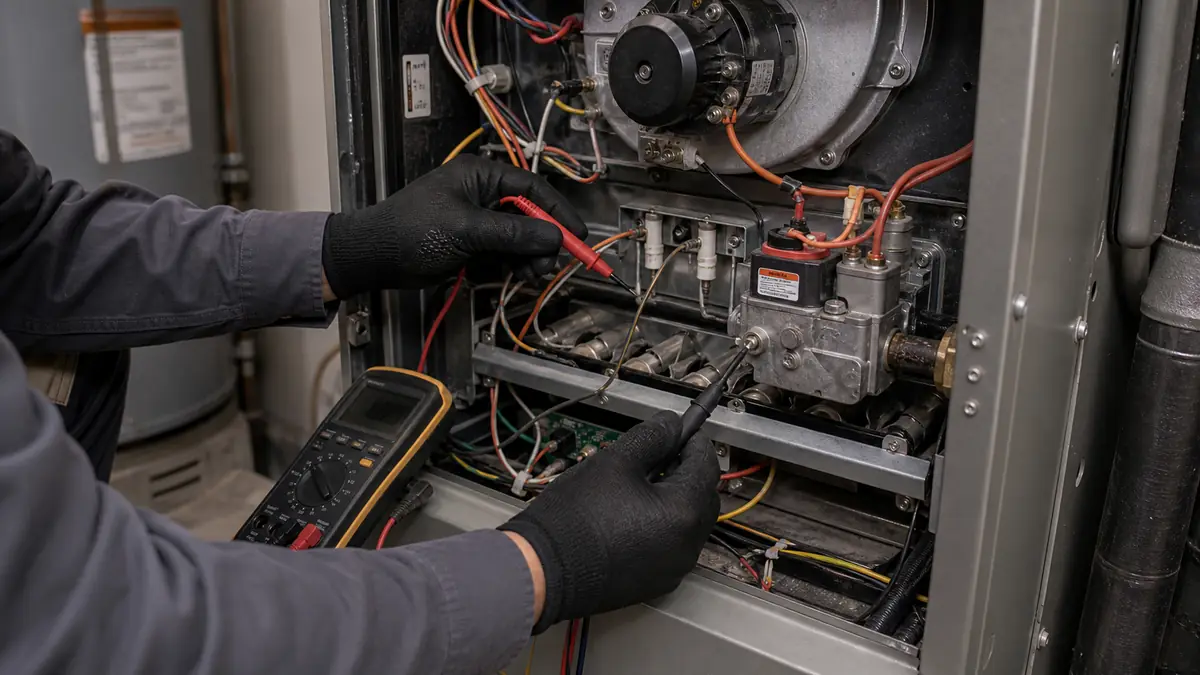
What do the Trane flash codes actually mean?
A Trane gas furnace runs a self-check on every call for heat, and when something fails the safety logic the integrated furnace control parks the burners and blinks an amber LED to report it. Each count maps to a specific fault, so the blink pattern is a diagnosis, not just a warning light. In the foothill homes around Santa Anita Oaks and Upper Rancho we read these codes on nearly every no-heat call before we touch a single part. The table below covers the real codes we see most on Trane and American Standard boards in Arcadia.
| Flashes | Meaning | First check |
|---|---|---|
| 2 flashes | System lockout after failed ignition retries | Hot-surface igniter, flame sensor, gas supply |
| 3 flashes | Pressure switch open or stuck | Blocked flue, weak inducer, condensate trap |
| 4 flashes | Open high-limit from overheating | Dirty filter, closed registers, low airflow |
| 5 flashes | Flame sensed with no call (or reversed polarity) | Line polarity, leaking gas valve, grounding |
| 6 flashes | Flame dropout or weak flame signal | Dirty flame rod, marginal gas pressure |
| 7 flashes | Gas-valve circuit error | Valve wiring, the valve coil, control board |
| Continuous | Reversed line polarity or no ground | Receptacle wiring, furnace ground path |
The two codes assigned to most Arcadia furnaces this season are the 2-flash lockout and the 7-flash gas-valve fault, and each has its own deep-dive page: Trane 2 flashes and Trane 7 flashes. Start with the count, then follow the matching page for the full diagnostic walkthrough.
How do we read codes on a Trane in Arcadia homes?
We treat the blink count as a lead, never a verdict. A pit crew does not swap a tire because a light came on - they confirm the reading first, and so do we. After we count the amber pattern through the sight window, we pull the diagnostic label glued inside that furnace door, because a board revision can shift a code by one. Then we verify with instruments: a meter on the flame-sense microamps, a manometer on the gas manifold pressure, a clamp on the inducer amps, and a static-pressure probe across the filter and coil. In the older Lower Rancho ranches the furnace often sits in a tight closet or attic where heat builds up, so we also check that the cabinet is getting combustion air before we blame a sensor. Reading the code and confirming it is how we put the right part in once instead of guessing our way across the board.
Why do Arcadia furnaces throw these codes?
Arcadia's housing mix drives the pattern of faults we see. The mid-century ranches in Baldwin Stocker and Highland Oaks often run original or first-replacement furnaces where igniters have aged and flame sensors have coated, so 2-flash lockouts climb every fall. The Spanish and Mediterranean revival estates frequently have furnaces tucked into long attic runs with restrictive ductwork, which pushes high-limit and pressure-switch trips when filters load up. The newer mansionized rebuilds carry multi-stage and communicating equipment, so when those fault it is more often a control or gas-valve circuit issue reported on the XL850. The foothill climate matters too - Climate Zone 9 brings hot, dry summers that bake attic furnaces and dust that loads coils and flame rods, and the dry cold snaps off the San Gabriel Mountains drive the heaviest ignition load of the year.
How do we fix the codes once we read them?
Each code points at a short list of parts, so the repair is targeted. A 2-flash lockout usually ends with a new hot-surface igniter or a cleaned or replaced flame sensor, confirmed by watching a clean light-off and a steady microamp signal - typically $150 to $400. A 3-flash pressure-switch fault means clearing a blocked flue or condensate trap or replacing a weak inducer. A 4-flash high-limit clears once airflow is restored - new filter, opened registers, sometimes a duct correction. A 7-flash gas-valve fault is repaired by correcting the valve wiring within the visit, or replacing the gas valve itself at roughly $300 to $700 when the coil has failed. We stock the common igniters, flame sensors, and pressure switches on the van, so most single-code repairs around Arcadia finish the same day. When a code traces to a cracked heat exchanger or a gas leak, we stop and red-tag rather than reset - those are safety calls, not parts swaps. For the full repair path see our Arcadia furnace repair page, and for tune-ups that head off these faults, our maintenance plans.
When is a Trane code an emergency?
Most codes are a same-day repair, not a midnight call - but a few are not. Shut the gas off and call right away if you smell gas, if the furnace keeps trying to light and will not stop, if you see soot or scorching around the burner area, or if a rollout switch keeps tripping. Those point at a gas-valve leak, a cracked or blocked heat exchanger, or flame rollout, and resetting the board only buys time before a real failure. A persistent 7-flash gas-valve code is worth treating with the same caution, because a valve that will not prove safe should not be force-cycled. If a code returns immediately after a reset, treat it as the system protecting you and let us read it. Reach us through our emergency service page or the number below for after-hours foothill response.
Common questions
Where do I read the error code on a Trane furnace?
Look through the small sight window on the lower furnace door for an amber LED on the integrated furnace control. Count the blink pattern between pauses - two flashes, three flashes, and so on. On a communicating XV system the XL850 ComfortLink II thermostat shows a written alert instead of a blink count.
Is a flashing code the same on every Trane model?
Mostly, but not exactly. Most single-stage and two-stage Trane and American Standard gas furnaces share the same flash map, yet board revisions shift a code or two. We confirm the count against the diagnostic label inside that specific furnace door before we condemn a part.
Can I clear a Trane fault code myself in Arcadia?
You can cycle power at the furnace switch once to clear a soft lockout, and replacing a clogged filter clears many airflow faults. If the same code returns, stop resetting it - a repeated lockout on gas, flame, or limit can point to a real safety issue. Call us before the part that tripped fails outright.
Do these codes cover Trane heat pumps and AC too?
The amber blink codes are a furnace-board feature. Trane heat pumps and straight-cool condensers report through the ComfortLink II control or a defrost board instead. We read both - furnace flashes in the cabinet and system alerts on the XL850 - so we cover heating and cooling faults on one visit.