Arcadia HVAC Maintenance Calendar
Answer in brief: In Arcadia, CA (91006), schedule a Trane cooling tune-up in late winter to early spring and a furnace check in fall, and change filters every 1 to 3 months. Arcadia Trane HVAC builds this calendar around San Gabriel foothill heat, so call (213) 772-7221 or book online to plan your visits.
Key points
- Spring (Feb-Apr): cooling tune-up before foothill heat - coil wash, charge, capacitor load test.
- Fall (Sep-Nov): furnace inspection before the first cold night - igniter, flame sensor, heat exchanger.
- Filters: every 1 to 3 months; more often during dusty Santa Ana conditions.
- Arcadia runs 45 to 65 days a year above 90 F, so cooling maintenance is the priority.
- Documented annual service keeps a registered Trane XV20i or XL18i warranty defensible.
- DIY between visits: filters, clear the condenser, gentle coil rinse; leave gas/electrical to a tech.
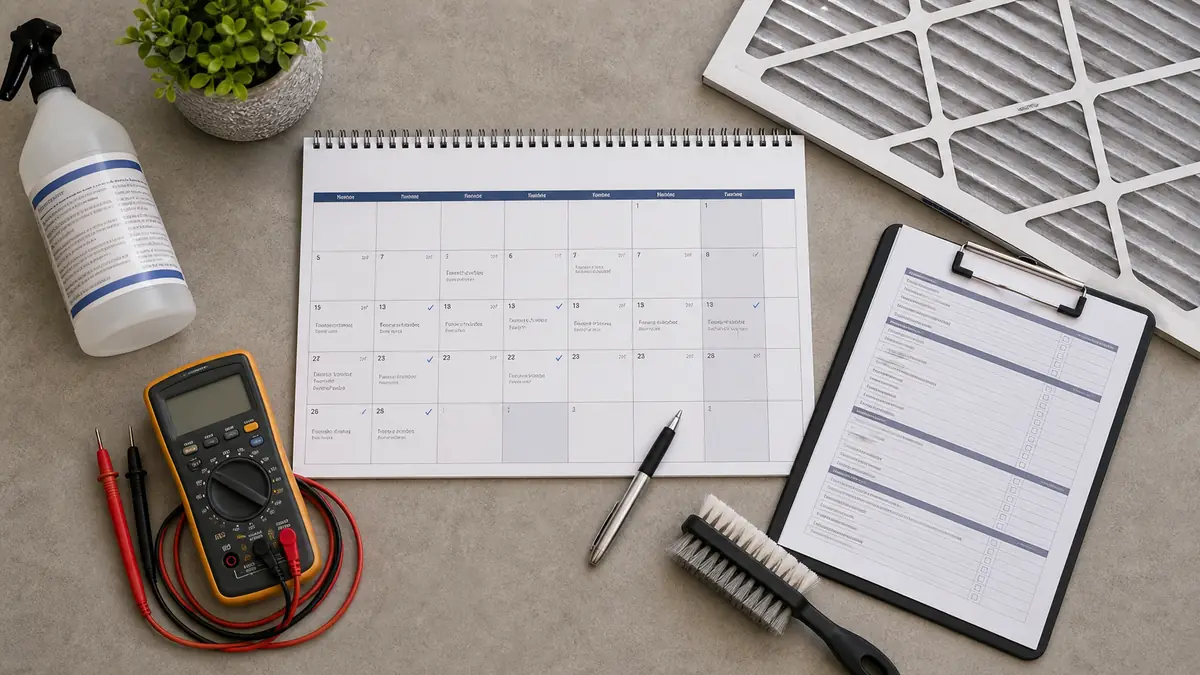
Why does Arcadia need its own maintenance rhythm?
Generic maintenance advice assumes a balanced heating and cooling load. Arcadia does not have one. Sitting in the San Gabriel foothills in Title-24 Climate Zone 9, the city runs a long, hard cooling season - July highs around 91 to 95 F, 45 to 65 days a year above 90 F, and Santa Ana spikes past 100 F - against mild winters. That means your maintenance dollars should weight heavily toward cooling readiness, with a lighter but real furnace check in fall. The dusty Santa Ana season also means filters and the outdoor coil clog faster here than on the coast.
What should I do each season?
Think of the year in four moves: tune cooling before the heat, ride through summer with clean filters and a clear condenser, check heating before the cold, and rest the system in deep winter. The table below is the schedule we actually run for Arcadia homes, with the why behind each item.
| Window | Task | Why it matters in Arcadia |
|---|---|---|
| Feb-Apr | Cooling tune-up: coil wash, charge, capacitor and contactor check | Catch weak parts before the first heat wave, not during one |
| May-Aug | Change filters monthly, keep condenser clear, gentle coil rinse | Heavy runtime and Santa Ana dust clog filters and the Spine Fin coil fast |
| Jun-Sep | Watch for short cycling, ice, or weak airflow; treat the condensate drain | Long cooling season clogs drains and exposes charge or duct issues |
| Sep-Nov | Furnace inspection: igniter, flame sensor, pressure switch, heat exchanger | Unused furnace parts fail on the first cold night |
| Dec-Jan | Light heating use; replace filter; note any odd furnace flash codes | Mild winter, but safety checks still matter for combustion |
Month-by-month: what to do and when in Zone 9
Arcadia's calendar is lopsided toward cooling, so the months are not interchangeable. Here is the full twelve-month rhythm we actually run, tuned to San Gabriel foothill heat rather than a generic national template. Notice that the heavy work lands February through April and September through October - the shoulders on either side of the hard cooling season - because that is when a tech can find a weak part on a calm day instead of during a 102 F Santa Ana when the whole valley is calling at once.
| Month | Do this | Why here |
|---|---|---|
| January | Replace the furnace filter; note any amber flash codes during heating runs | Mild winter, but combustion safety still counts; a 4-flash high-limit hints at airflow trouble |
| February | Book the spring cooling tune-up; clear winter debris off the condenser | Beat the rush - slots fill once the first 90 F day hits |
| March | Capacitor load test, contactor inspection, Spine Fin coil wash | A bulging dual-run capacitor caught now is a calm-day swap, not a heat-wave emergency |
| April | Verify refrigerant charge by superheat and subcool; confirm thermostat staging | Correct charge before runtime climbs prevents iced coils in May |
| May | Start monthly filter checks; clear two feet around the outdoor unit | Cooling runtime ramps; a clogged 1-inch filter ices coils fast |
| June | Gentle inside-out coil rinse if dusty; treat the condensate drain | Long season plus algae clogs marginal drains mid-summer |
| July | Watch amps and cooling on the hottest days; act on any short cycling early | Peak 91-95 F load exposes weak compressors and undersized returns |
| August | Re-check filters after Santa Ana dust events; listen for hard-start noise | Blowing dust coats the Spine Fin coil and chokes airflow |
| September | Book the fall furnace inspection while still cooling | First cold night is when an unused igniter or flame sensor fails |
| October | Furnace check: igniter, flame sensor, pressure switch, heat exchanger scope | Catch a cracked or sooted exchanger before you rely on heat |
| November | Test heating on a cool morning; confirm the inducer and limit cycle cleanly | A 3-flash pressure-switch fault surfaces on the first real call for heat |
| December | Replace the filter; keep registers and the flue area clear | Light heating use, but a blocked flue is a carbon-monoxide risk |
If you only do four things all year, make them these: a March cooling tune-up, an October furnace check, a fresh filter every one to three months, and a clear two-foot zone around the condenser. Those four catch the failures that strand Arcadia homeowners during the heat and on the first cold snap.
How does Trane equipment change the maintenance plan?
The platform under your house decides what gets checked. A value Climatuff XR single-stage condenser is mostly about the dual-run capacitor, the contactor, the charge, and a clean Spine Fin coil - simple, mechanical, and cheap to keep healthy. A two-stage XL18i adds a second compressor stage and staging logic that a tech confirms is switching correctly. A variable-speed XV20i paired with an XL850 or XL824 ComfortLink II thermostat is a communicating system: the tune-up includes reading the thermostat's plain-language alerts, checking the 4-wire communication bus, and verifying the inverter is modulating instead of locked at one speed.
On the heat side, an 80% AFUE XR80 furnace is a straightforward igniter-flame-sensor-limit machine, while a modulating XC95m or two-stage S9V2 with a variable-speed ECM blower needs the staging and blower ramp verified along with combustion. The more communicating and variable-speed your system, the more a documented annual visit earns its keep - both for performance and for keeping the registered Trane parts warranty defensible if a compressor or board fails later.
What does a professional visit catch that I cannot?
A tech meters the dual-run capacitor under load (a meter, not a guess), checks refrigerant charge by superheat and subcool, washes the all-aluminum Spine Fin coil, inspects the contactor for pitting, clears and treats the condensate drain, and on the heat side scopes the igniter, flame sensor, burners, and heat exchanger for cracks with a combustion analyzer. Those are the failures that strand Arcadia homeowners mid-summer or mid-cold-snap, and they are exactly what a homeowner cannot safely check. Our maintenance plan bundles the two seasonal visits.
What can I safely do myself between visits?
Plenty, and it matters. Change filters on schedule - of all the iced coils and tripped high-limits we get called to in Arcadia, a choked filter is the cause we run into more than any other. Keep leaves and Santa Ana debris off the outdoor unit and maintain two feet of clearance so it can reject heat. When the coil looks dusty, shut the power off and rinse it gently from the inside out with a hose, never a pressure washer. Pour a cup of white vinegar down an accessible condensate drain access to slow algae. Stop there - refrigerant, electrical, and gas work belong to a licensed tech.
What does skipping maintenance actually cost in Arcadia?
The failures here are a chain, not random bad luck, and each skipped step feeds the next. Skip the filter change and static pressure climbs; the blower works harder, the coil ices in summer or the furnace trips a 4-flash high-limit in winter. Skip the spring capacitor load test and a part already drifting below its rated microfarads waits until a 100 F Santa Ana to fail - now it is an emergency call at an after-hours rate instead of a calm $150 to $450 swap. Skip the coil wash and a Santa Ana-dusted Spine Fin coil cannot reject heat, so head pressure climbs, the compressor runs hot, and you trade a $200 cleaning for compressor wear measured in the thousands. Skip the drain treatment and a clogged condensate line backs up into the pan, soaks the control board or the drywall, and turns a $150 flush into water damage.
None of that is scare-selling - it is the cause-and-effect we watch play out every summer on systems that went years between visits. Two documented visits a year, plus filters, is the cheapest insurance against the expensive failures, and it keeps a registered Trane warranty claim defensible if a major part does let go.
Does a heat pump change the maintenance year?
It does, because a heat pump works both seasons. A Trane XV20i heat pump cools all summer and then runs in reverse for heat on cool Arcadia nights, so the spring and fall visits both matter and the system never gets the long winter rest a cooling-only AC enjoys. The fall visit shifts focus: instead of combustion checks on a gas furnace, the tech verifies the reversing valve shifts cleanly, the defrost cycle works, and the auxiliary or backup heat staging is correct. The outdoor coil still needs the same dust management, and because the unit runs year-round, the capacitor and contactor see more total cycles. If you electrify off gas, fold a brief mid-fall heating-mode check into the calendar above.
How does maintenance tie into bigger decisions?
Maintenance is also your early-warning system for repair-versus-replace. A tune-up that turns up a weak compressor, a leaking Spine Fin coil, and a 13-year-old unit is telling you to start planning, not just patching. When that day comes, the SEER2 and rebate guide walks through efficiency tiers and live incentives, and the XV20i and XL18i pages explain which system fits your home. If something is already acting up, jump to short cycling or AC not cooling.
Common questions
When should I schedule AC maintenance in Arcadia?
Late winter to early spring, before the foothill heat builds - ideally February through April. Booking the cooling tune-up before the first 90 F stretch means a weak capacitor or low charge gets caught on a calm day instead of failing during a Santa Ana heat spike when everyone needs a tech.
How often should I change my furnace and AC filter here?
Every 1 to 3 months during heavy cooling season, more often during dusty Santa Ana conditions. A 1-inch filter in a hard-running Arcadia system clogs fast; a clogged filter raises static pressure, ices coils, and can trip the furnace high-limit. Check it monthly in summer and replace when it looks gray.
Do I really need a fall furnace check if Arcadia winters are mild?
Yes. Mild does not mean unused - the first cold night of the year is exactly when an unused furnace with a crusted flame sensor or worn igniter locks out. A short fall inspection clears those parts and verifies the heat exchanger is safe before you rely on it.
What can I do myself between professional visits?
Change filters on schedule, keep the outdoor condenser clear of leaves and Santa Ana debris, hose the Spine Fin coil gently from inside out when it is dusty, keep two feet of clearance around the unit, and pour a cup of vinegar down an accessible condensate drain access. Leave refrigerant, electrical, and gas work to a tech.